
Financial markets are among the most important institutions in the modern global economy. Every day, trillions of dollars move across borders as governments borrow money, companies raise capital, investors buy and sell securities, banks exchange currencies, and businesses hedge financial risks.
But what exactly are global financial markets?
At their core, financial markets are systems that allow capital, risk, and financial assets to move between those who have funds and those who need them. They connect governments, corporations, banks, institutional investors, traders, and individual investors across countries.
For anyone studying finance, economics, trading, or financial engineering, understanding these markets is essential because no major financial market operates completely in isolation.
1. What Are Global Financial Markets?
A financial market is a marketplace where financial assets are issued, bought, sold, or exchanged.
These markets help perform several fundamental economic functions:
- Capital formation – businesses and governments can raise funds.
- Price discovery – markets determine prices through supply and demand.
- Liquidity – investors can convert financial assets into cash.
- Risk transfer – derivatives and other instruments allow participants to manage risk.
- Investment – individuals and institutions can invest their savings.
- International capital allocation – money can move from one country or economy to another.
Financial markets can operate through organized exchanges or through over-the-counter (OTC) networks. Exchanges establish institutional rules and centralize trading information, while OTC markets allow participants to trade directly or through dealers.
This distinction is particularly important in the foreign exchange and derivatives markets.
2. The Major Components of the Global Financial Markets
The global financial system is not one single market. It is an interconnected network of several major markets.
The major categories include:
- Equity markets
- Bond and fixed-income markets
- Foreign exchange markets
- Commodity markets
- Derivatives markets
- Money markets
- Cryptocurrency and digital-asset markets
Each serves a different purpose, but movements in one market can influence the others.
3. Equity Markets: The World of Stocks
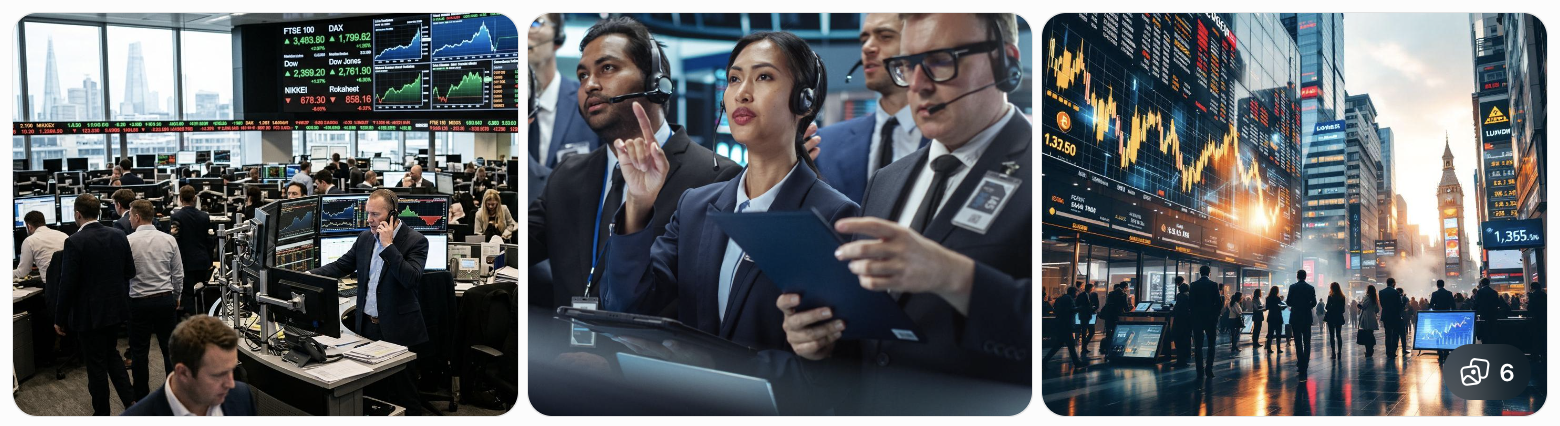
The equity market is where ownership interests in companies are bought and sold.
When an investor purchases shares of a company, the investor acquires an ownership interest in that company.
Examples of major stock markets include:
- United States
- Japan
- United Kingdom
- China
- Hong Kong
- Germany
- India
- Canada
- Australia
Stock exchanges provide organized environments for trading securities.
Some well-known exchanges include the New York Stock Exchange, Nasdaq, London Stock Exchange, Tokyo Stock Exchange, and Hong Kong Stock Exchange.
Why do companies issue shares?
Companies can raise capital through equity financing rather than borrowing.
For example:
A technology company wants to raise $500 million to expand its operations.
Instead of borrowing the entire amount from a bank, it may sell shares to investors.
The company receives capital, while investors receive ownership and potentially benefit from:
- capital appreciation
- dividends
- voting rights
However, shareholders also bear the risk that the value of their investment may decline.
4. Bond & Fixed-Income Markets
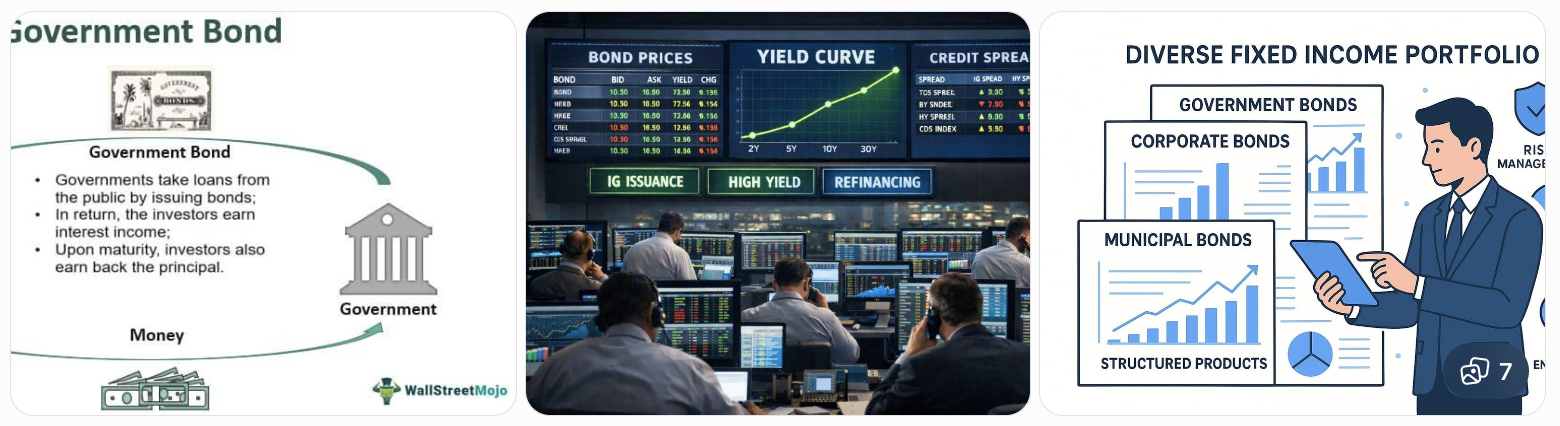
While stocks represent ownership, bonds generally represent debt.
When an investor purchases a bond, the investor is essentially lending money to the issuer.
Bond issuers can include:
- Governments
- Corporations
- Banks
- Municipalities
- International institutions
For example, suppose a government issues a 10-year bond with a face value of $1,000 and a fixed coupon.
An investor purchases the bond and receives interest payments according to the bond's terms. At maturity, the principal is repaid.
Why are bond markets important?
Bond markets help finance:
- Government expenditures
- Infrastructure
- Corporate expansion
- Housing
- International development
They also play a crucial role in determining interest rates and borrowing costs throughout the economy.
5. Foreign Exchange Market
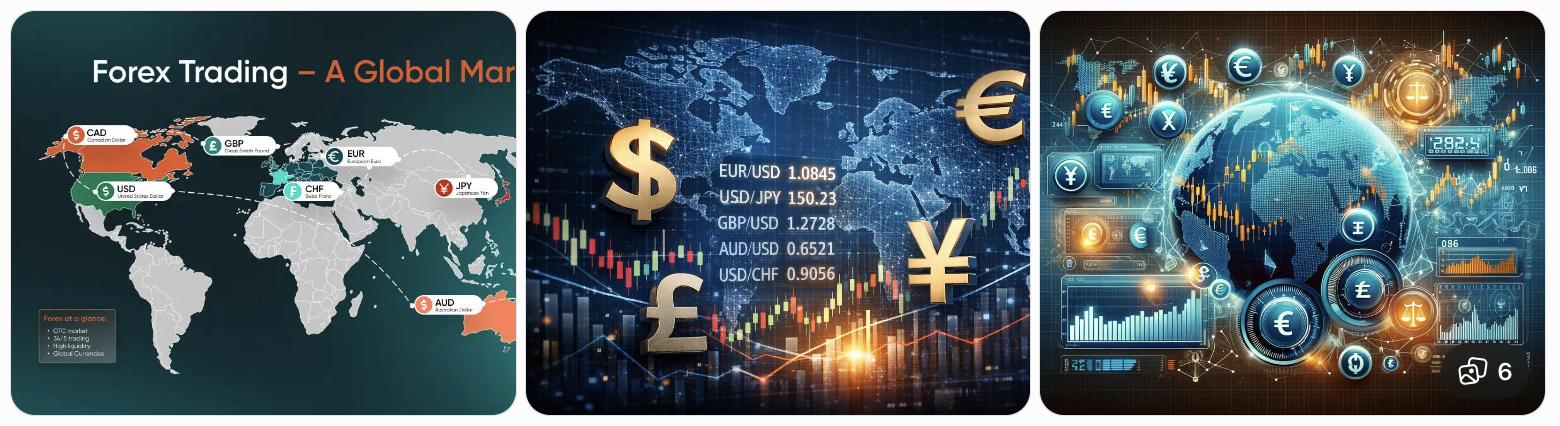
The foreign exchange market, or Forex/FX market, is where currencies are exchanged.
For example:
EUR/USD
represents the exchange rate between the euro and the U.S. dollar.
If EUR/USD rises from 1.1000 to 1.1200, the euro has appreciated relative to the dollar.
The FX market is essential because international trade and investment require currencies to be exchanged.
A company in Japan purchasing equipment from Germany may need to exchange Japanese yen for euros.
Similarly, an investor in the Philippines purchasing a U.S. stock needs to convert Philippine pesos into U.S. dollars.
How large is the FX market?
The foreign exchange market is enormous.
According to the Bank for International Settlements' 2025 Triennial Survey, global FX turnover reached approximately $9.6 trillion per day in April 2025, up 28% from 2022.
The U.S. dollar remained the dominant currency, appearing on one side of approximately 89% of all FX transactions in the survey.
This demonstrates why FX is so important to global finance.
6. Commodity Markets
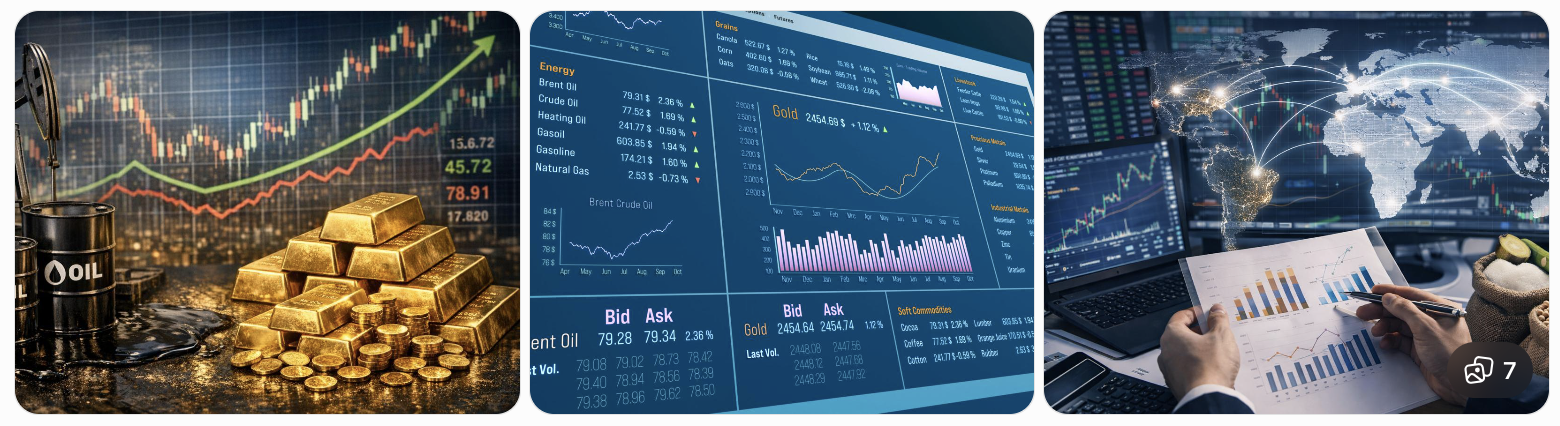
Commodity markets involve the trading of physical raw materials and resources.
Major commodities include:
Energy
- Crude oil
- Natural gas
- Electricity
Metals
- Gold
- Silver
- Copper
- Platinum
Agricultural products
- Wheat
- Corn
- Soybeans
- Coffee
- Sugar
Commodities are important not only because they are traded as investments, but because they are fundamental inputs into economic activity.
For example:
Oil ↑ → transportation costs may rise → production costs may rise → inflationary pressure may increase.
Likewise:
Copper demand ↑ → copper prices may rise → investors may interpret this as a signal of stronger industrial activity.
Commodity prices can therefore influence currencies, inflation, interest rates, corporate earnings, and stock markets.
7. 📊 Derivatives Markets

A derivative is a financial instrument whose value is derived from an underlying asset or reference variable.
The underlying may be:
- A stock
- Currency
- Commodity
- Interest rate
- Bond
- Stock index
- Cryptocurrency
Common derivatives include:
Futures
A futures contract creates an obligation to buy or sell an underlying asset at a specified price and date.
Options
An option gives the holder the right, but generally not the obligation, to buy or sell an underlying asset at a specified price.
Forwards
A forward is a customized agreement between parties to buy or sell an asset at a future date.
Swaps
Swaps involve exchanging financial cash flows according to specified terms.
Derivatives are used for both:
Risk management and speculation.
For example, an airline might use fuel derivatives to reduce exposure to rising fuel prices.
A trader, meanwhile, might use derivatives to speculate on the future movement of oil prices.
The BIS reported that OTC interest-rate derivatives turnover reached approximately $7.9 trillion per day in April 2025.
8. Money Markets

The money market deals primarily with short-term borrowing and lending.
These instruments generally have relatively short maturities.
Examples include:
- Treasury bills
- Commercial paper
- Certificates of deposit
- Repurchase agreements
- Short-term interbank instruments
Money markets are particularly important to banks, corporations, governments, and financial institutions because they help manage short-term liquidity.
Think of the money market as part of the financial system's short-term funding mechanism.
9. Cryptocurrency and Digital-Asset Markets
One of the most significant developments in modern finance has been the emergence of digital assets.
Cryptocurrencies such as Bitcoin introduced a different approach to transferring and recording value using blockchain technology.
The broader digital-asset ecosystem now includes:
- Cryptocurrencies
- Stablecoins
- Tokenized assets
- Decentralized finance
- Digital wallets
- Blockchain-based financial applications
Digital assets have also raised new questions regarding:
- Regulation
- Monetary policy
- Financial stability
- Cybersecurity
- Investor protection
- Cross-border payments
The IMF has highlighted the growing importance of stablecoins and private credit markets, particularly in emerging markets, as areas requiring continued monitoring.
How Global Financial Markets Are Connected?
This is perhaps the most important concept for students and traders to understand.
Financial markets do not operate independently.
Consider this simplified chain:
Central Bank → Interest Rates → Bonds → Currency → Stocks → Commodities → Global Capital Flows
A decision by a major central bank can therefore influence markets around the world.
Example
Suppose a major central bank raises interest rates.
Higher interest rates may:
- Increase the attractiveness of assets denominated in that currency.
- Influence capital flows.
- Affect the exchange rate.
- Increase borrowing costs.
- Put pressure on stock valuations.
- Affect bond prices and yields.
- Influence commodity prices.
- Change investor risk appetite.
One policy decision can therefore create a chain reaction across multiple asset classes.
The Role of Central Banks
Central banks are among the most influential institutions in global financial markets.
Examples include:
- Federal Reserve — United States
- European Central Bank — Euro area
- Bank of Japan — Japan
- Bank of England — United Kingdom
- People's Bank of China — China
- Bangko Sentral ng Pilipinas — Philippines
Central banks influence financial conditions through tools such as:
- Policy interest rates
- Open-market operations
- Reserve requirements
- Liquidity facilities
- Asset purchases or sales
- Forward guidance
Their decisions can affect almost every major financial market.
Interest Rates: The Invisible Force Behind Markets
Interest rates are one of the most important variables connecting financial markets.
Consider the relationship between bond prices and yields.
Generally:
Bond prices ↑ → Bond yields ↓
and
Bond prices ↓ → Bond yields ↑
Interest rates also influence stock valuation.
If interest rates rise, future corporate cash flows may be discounted at a higher rate, potentially reducing the present value investors assign to stocks.
Interest rates can also influence currencies.
Higher relative interest rates may attract capital into a currency, although the actual exchange-rate response depends on expectations, inflation, growth, risk, and many other factors.
Inflation and Financial Markets
Inflation is another major driver.
When inflation rises unexpectedly, investors may begin to anticipate tighter monetary policy.
This can produce:
Inflation ↑ → Expected interest rates ↑ → Bond yields ↑ → Financial conditions tighten
But the effect on equities is more complicated.
Some companies can pass higher costs to consumers, while others may experience declining profit margins.
This is why investors do not simply ask:
"Is inflation high?"
They ask:
"Is inflation higher or lower than the market expected?"
Expectations are extremely important in financial markets.
Geopolitical Events and Global Markets
Financial markets respond rapidly to geopolitical developments.
Examples include:
- Wars
- Elections
- Trade restrictions
- Sanctions
- Political instability
- Diplomatic conflicts
- Changes in international alliances
These events can affect:
- Oil prices
- Gold
- Currencies
- Government bonds
- Stock markets
- Credit spreads
The IMF's April 2026 Global Financial Stability Report, for example, highlighted geopolitical conflict, inflation pressures, tighter financial conditions, and cross-border portfolio flows as important sources of financial stability risk.
Investor Sentiment and Risk Appetite
Markets are driven not only by economic data but also by expectations and psychology.
Investors may be described as having:
Risk-on sentiment
Investors become more willing to hold riskier assets.
Potential beneficiaries can include:
- Equities
- Emerging-market assets
- High-yield credit
- Some commodities
- Higher-beta currencies
Risk-off sentiment
Investors become more concerned about preserving capital.
Capital may move toward perceived safe-haven assets, depending on the circumstances.
This creates an important principle:
Financial markets price expectations about the future, not simply the present.
The Rise of Technology in Financial Markets
Technology has transformed global finance.
Trading has increasingly moved from traditional telephone-based or floor-based processes toward sophisticated electronic systems.
Today, financial institutions use:
- Algorithmic trading
- High-frequency trading
- Artificial intelligence
- Machine learning
- Quantitative models
- Big-data analytics
- Automated risk management
- Cloud computing
- Blockchain technology
The FX market is a particularly good example. The BIS describes FX as a decentralized and fragmented market in which electronic trading and multiple venues play important roles.
This transformation has created an entirely new field:
Quantitative Finance
Quantitative finance combines:
Mathematics + Statistics + Programming + Economics + Finance
to analyze markets and construct systematic investment and trading strategies.
How Money Flows Around the World?
Imagine an investor in the Philippines investing in a U.S. technology company.
The process may involve:
Philippine Peso
↓
Foreign Exchange Market
↓
U.S. Dollar
↓
Broker/Custodian
↓
U.S. Equity Market
↓
Technology Company
The investment itself may also generate dividends or capital gains.
Eventually:
U.S. Dollar → FX Market → Philippine Peso
This simple example demonstrates how multiple financial markets interact.
The Major Participants
Global financial markets involve many different participants.
Governments
Raise capital and manage public finances.
Central Banks
Conduct monetary policy and support financial stability.
Commercial Banks
Provide credit, liquidity, payments, and financial intermediation.
Investment Banks
Assist companies and governments with capital raising, mergers, securities issuance, and trading.
Asset Managers
Manage portfolios for institutions and individuals.
Hedge Funds
Use a wide variety of strategies, often including leverage and derivatives.
Pension Funds
Invest long-term capital to meet future obligations.
Insurance Companies
Invest premiums while managing liabilities and risks.
Corporations
Raise capital and hedge financial exposures.
Retail Investors
Individuals who invest or trade financial assets.
Quantitative Traders
Use mathematical and computational models to identify opportunities and manage risk.
Why Global Financial Markets Matter to Ordinary People
You do not need to be a professional trader to be affected by financial markets.
Financial markets influence:
- Mortgage rates
- Loan rates
- Credit-card interest
- Pension funds
- Retirement accounts
- Investment returns
- Currency exchange rates
- Fuel prices
- Commodity prices
- Inflation
- Employment
- Government borrowing costs
For example, when the global price of crude oil increases, the effects can eventually reach transportation costs and consumer prices.
Similarly, changes in global interest rates can influence borrowing costs for households and businesses.
The Risks of Global Financial Markets
Financial markets provide enormous benefits, but they also create risks.
Major risks include:
Market Risk
The value of an asset can decline.
Credit Risk
A borrower may fail to meet its obligations.
Liquidity Risk
An asset may become difficult to sell without significantly affecting its price.
Currency Risk
Exchange-rate movements can affect investments and businesses.
Interest-Rate Risk
Changes in interest rates can affect bonds, stocks, currencies, and borrowing costs.
Systemic Risk
Problems in one part of the financial system can spread to other institutions or markets.
Operational and Cyber Risk
Technology failures, cyberattacks, or operational mistakes can disrupt financial infrastructure.
The interconnected nature of financial markets is precisely why financial stability matters. The IMF continues to identify vulnerabilities involving asset valuations, sovereign debt markets, nonbank financial institutions, and cross-border capital flows.
Emerging Markets vs. Developed Markets
Not all financial markets have the same level of development.
Developed markets
Generally have:
- Deep liquidity
- Mature financial institutions
- Developed regulatory systems
- Large institutional investor bases
- Sophisticated financial infrastructure
Examples include the United States, Japan, United Kingdom, Germany, and other advanced economies.
Emerging markets
Often have:
- Rapid economic growth
- Developing capital markets
- Greater sensitivity to global capital flows
- Potentially higher volatility
- Greater currency and political risks
Emerging markets can therefore offer attractive opportunities while also carrying additional risks.
The IMF has noted that cross-border portfolio flows can provide important financing opportunities for emerging markets while also making some economies more sensitive to shifts in global risk sentiment.
The Global Financial Market as One Ecosystem
One of the best ways to understand financial markets is to think of them as an interconnected ecosystem.
For example:
Economic Growth
↓
Corporate Earnings
↓
Stock Markets
At the same time:
Inflation
↓
Central Bank Policy
↓
Interest Rates
↓
Bond Markets
↓
Currency Markets
Meanwhile:
Geopolitical Conflict
↓
Energy Prices
↓
Inflation Expectations
↓
Monetary Policy Expectations
↓
Global Asset Prices
Everything is connected.
Why Traders Need to Understand Global Financial Markets?
A trader who focuses exclusively on charts may miss some of the forces driving those charts.
For example, a currency pair may suddenly move because of:
- A central-bank decision
- Inflation data
- Employment data
- GDP figures
- Geopolitical developments
- Bond-yield movements
- Commodity-price changes
- Changes in market expectations
This is why professional trading often combines several disciplines:
Technical Analysis
Fundamental Analysis
Macroeconomics
Risk Management
Quantitative Analysis
The more interconnected markets become, the more valuable it becomes to understand the relationships between them.
From Traditional Finance to Quantitative Finance
The evolution of global financial markets has created enormous quantities of financial data.
Prices, volumes, interest rates, economic indicators, correlations, volatility, and order-flow information can now be analyzed computationally.
This has enabled the development of:
- Algorithmic trading
- Statistical arbitrage
- Quantitative portfolio management
- Systematic investing
- Machine-learning models
- Automated risk management
- Portfolio optimization
A quantitative trader might ask:
"Can historical relationships between assets be used to construct a systematic strategy?"
A portfolio manager might ask:
"How can capital be allocated across assets to maximize expected return for a given level of risk?"
These questions demonstrate how financial markets have evolved from traditional trading floors into highly sophisticated information-processing systems.
The Future of Global Financial Markets
The financial markets of the future will likely become even more:
Digital → Automated → Data-driven → Global → Interconnected
Several trends are particularly important:
Artificial Intelligence
AI may increasingly assist with research, forecasting, portfolio construction, fraud detection, and risk management.
Algorithmic Trading
Automated systems will continue to play an important role in price discovery and liquidity provision.
Digital Assets
Blockchain-based assets and tokenization may continue to influence how financial assets are issued and transferred.
Faster Payments
Cross-border payments are likely to become increasingly automated and efficient.
Greater Data Integration
Financial decisions will increasingly incorporate alternative data, real-time economic information, and machine-readable information.
New Forms of Risk
Greater technological dependence also creates new cybersecurity, operational, and systemic risks.
The Big Picture
The global financial markets are much more than places where people buy and sell stocks.
They form a global network for allocating capital, transferring risk, discovering prices, and facilitating economic activity.
Stocks allow companies to raise equity.
Bonds allow governments and corporations to borrow.
Currencies allow international trade and investment.
Commodities provide essential resources.
Derivatives allow participants to manage and transfer risk.
Money markets provide short-term liquidity.
Digital assets introduce new technologies and financial structures.
And behind all of them are millions of participants responding to information, expectations, incentives, and risk.
Conclusion: Understanding the Financial World
The global financial markets represent one of humanity's most sophisticated economic systems.
From a farmer selling crops to an international corporation issuing bonds, from a central bank setting interest rates to an algorithm executing trades in milliseconds, countless transactions are connected through the global financial system.
For aspiring traders, investors, economists, engineers, and financial professionals, understanding this interconnected ecosystem is not merely an academic exercise.
It is the foundation for understanding how money moves, how prices are formed, how risk is transferred, and how economic events become financial-market movements.
And perhaps the most important lesson is this:
No financial market exists in isolation.
A movement in bonds can influence currencies.
Currencies can influence commodities.
Commodities can influence inflation.
Inflation can influence central banks.
Central banks can influence bonds and equities.
And all of these can influence investor behavior.
Understanding these relationships is the beginning of understanding global finance.
Understanding the Global Financial Markets