
Money is something we encounter every day. We earn it, spend it, save it, invest it, and increasingly, move it digitally with just a few taps on a smartphone.
Yet money has not always existed in the form we know today.
There was a time when people exchanged livestock for grain, tools for food, or other goods through barter. Over thousands of years, societies developed increasingly sophisticated ways of representing and transferring value—from shells and salt to precious metals, coins, paper notes, bank deposits, electronic payments, and cryptocurrencies.
The history of money is therefore much more than a history of coins and banknotes. It is a story of human innovation, trust, technology, trade, economics, and financial systems.
Let's take a journey through the major stages of monetary evolution.
1. Barter: The Beginning of Exchange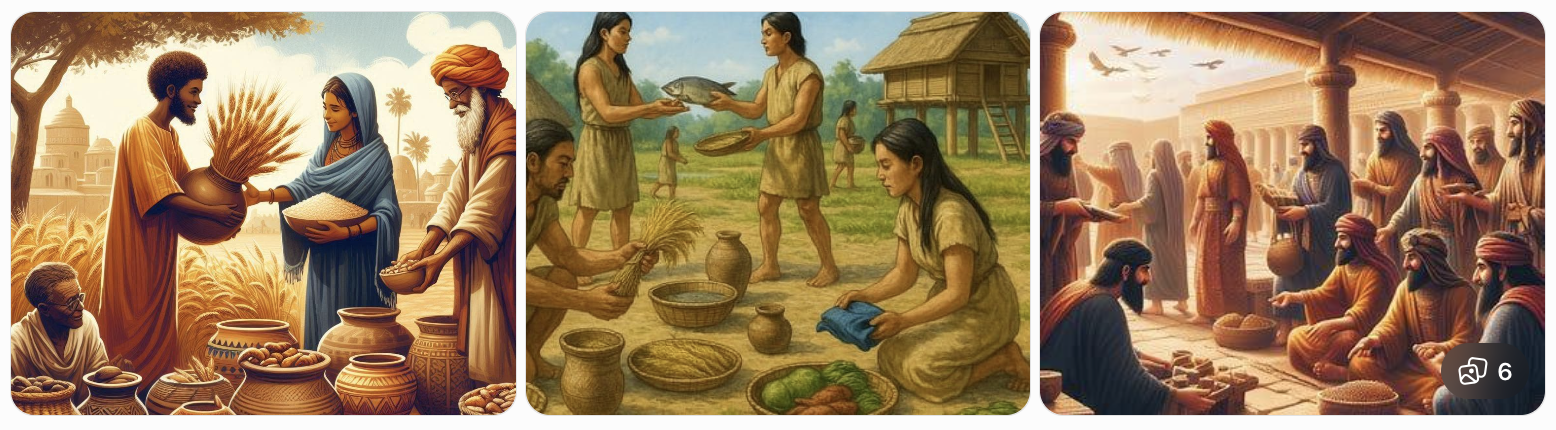
Before money existed, communities relied largely on barter, a system in which goods and services were exchanged directly for other goods and services.
For example, a farmer might exchange grain for tools made by a blacksmith. A fisherman could exchange fish for clothing or livestock.
The basic principle was simple:
I have something you want, and you have something I want.
However, barter had a fundamental problem known as the double coincidence of wants.
Imagine that a farmer wants a pair of shoes. The shoemaker, however, does not need grain. Instead, the shoemaker wants fish. The farmer would then need to find a fisherman who wants grain and is willing to trade fish for it.
As economies became larger and more complex, this became increasingly inefficient.
Barter also created other challenges:
- How much grain should be exchanged for one cow?
- How can the value of perishable goods be preserved?
- How can large transactions be conducted efficiently?
- How can wealth be stored for future use?
These problems encouraged societies to search for something that could function as a generally accepted medium of exchange.
And that led to the next stage.
2. Commodity Money: When Goods Became Money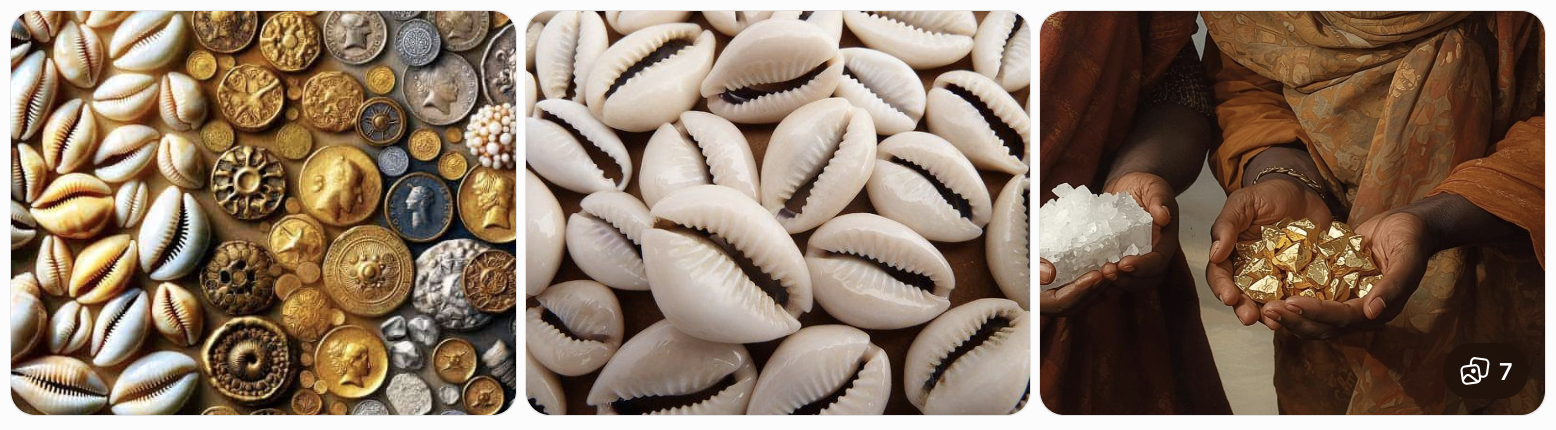
Instead of exchanging one product directly for another, societies began using certain goods as commonly accepted forms of payment.
These became known as commodity money.
Commodity money consisted of objects that had value either because they were useful themselves or because society widely accepted them as valuable.
Examples throughout history include:
- Salt
- Grain
- Livestock
- Cowrie shells
- Beads
- Furs
- Tea
- Tobacco
- Precious metals
Salt is a particularly interesting example. In several historical societies, it was highly valuable because it was essential for food preservation and consumption.
Cowrie shells were also used as money in various parts of the world because they were relatively durable, portable, recognizable, and difficult to obtain in certain regions.
Commodity money represented an important conceptual breakthrough.
People no longer had to find someone willing to exchange exactly what they wanted. Instead, they could accept a commonly valued commodity and later exchange it for something else.
Money was beginning to perform its fundamental economic functions:
Medium of exchange → Store of value → Unit of account
However, commodity money still had limitations.
Some commodities were difficult to transport. Others could deteriorate over time. Their quality could vary, and determining their exact value could be difficult.
This created demand for something more durable, portable, divisible, and universally recognizable.
3. Metal Coins: Standardizing Value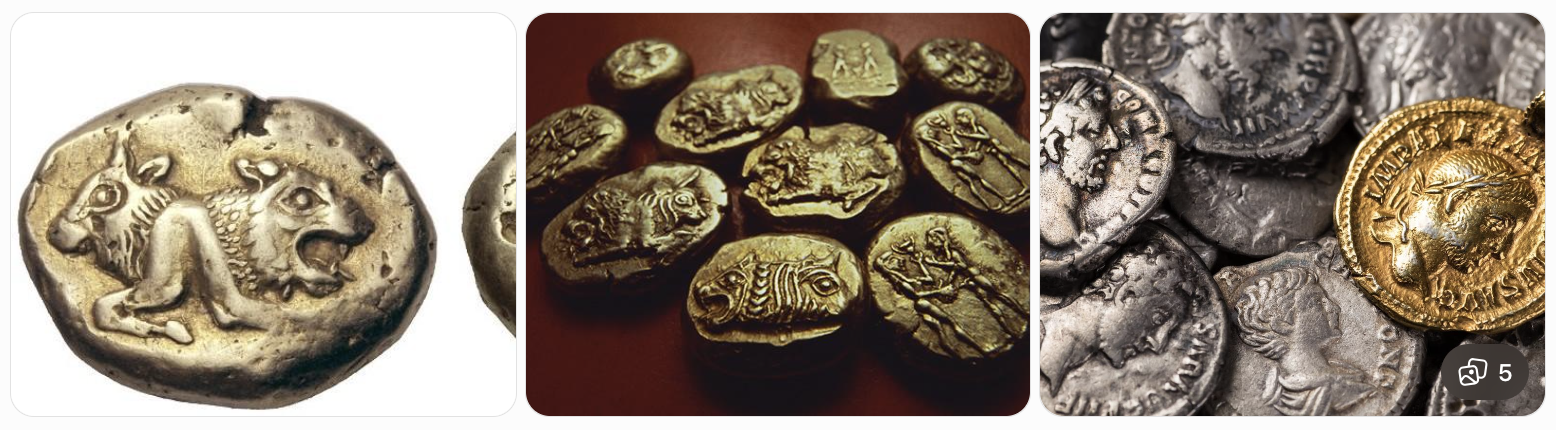
One of the most important developments in monetary history was the emergence of metal coins.
Precious metals such as gold, silver, and copper possessed several characteristics that made them particularly useful for monetary purposes:
- They were durable.
- They could be divided into smaller units.
- They were relatively portable.
- They were difficult to destroy.
- They could be melted and reused.
- They were widely valued.
The ancient kingdom of Lydia, located in what is now Turkey, is widely associated with some of the earliest standardized metal coinage, around the 7th century BCE.
Coins introduced something extremely important: standardization.
Instead of weighing raw pieces of metal for every transaction, governments or authorities could issue standardized pieces with identifiable markings.
A coin could communicate:
This piece contains a recognized amount of valuable material and is officially recognized for exchange.
Governments eventually began placing symbols, rulers' images, and inscriptions on coins.
This helped establish another crucial ingredient of money:
Trust.
People accepted coins not only because of the metal they contained but increasingly because they trusted the authority that issued them.
Coins consequently became an important foundation for taxation, trade, government finance, military expenditure, and economic development.
4. The Rise of Paper Money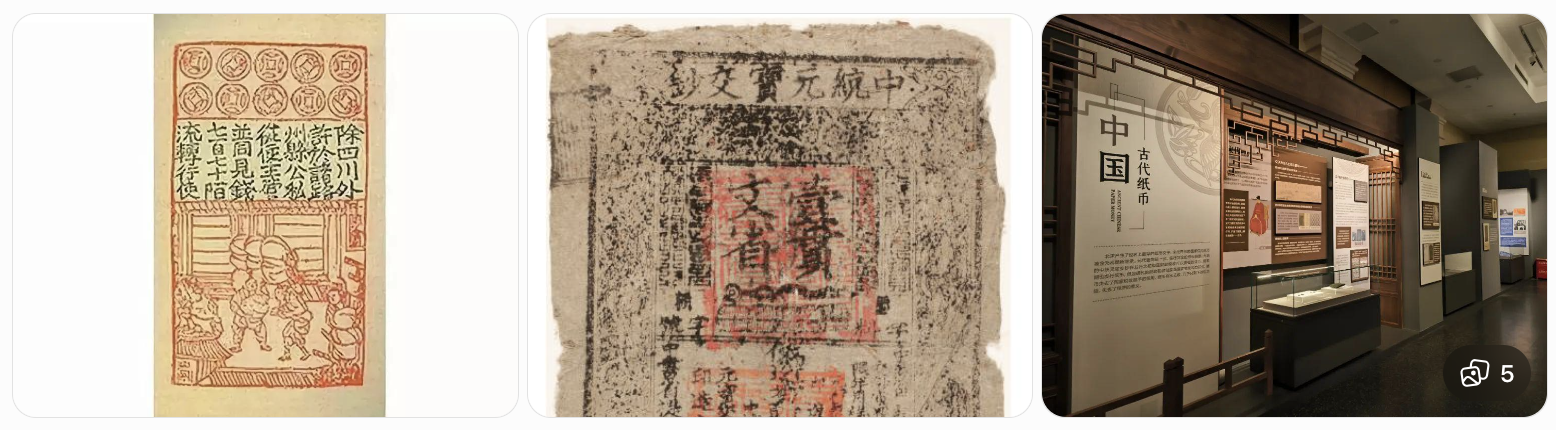
Metal coins were useful, but they had an obvious limitation:
They were heavy.
Imagine conducting a major commercial transaction using bags of silver or gold.
As economies expanded, merchants needed a lighter and more convenient way to represent value.
China played a major role in the development of paper money.
During the Tang and particularly the Song periods, financial instruments and paper-based forms of payment developed as merchants and governments searched for more efficient ways to conduct transactions.
One important early example was jiaozi, a form of paper currency associated with China during the Song Dynasty.
Paper money represented another major conceptual shift.
The physical material of the money no longer necessarily needed to possess intrinsic value equal to the amount written on it.
A piece of paper could represent significant purchasing power because people trusted that it would be accepted by others.
This principle would eventually become central to modern monetary systems.
5. Banking: Money Becomes a Financial System
Money did not evolve independently from banking.
As trade expanded across regions and continents, people needed institutions capable of storing wealth, facilitating transactions, extending credit, and transferring funds.
The development of banking transformed money from simply an object used in transactions into part of a much larger financial system.
Banks began performing several important functions:
- Accepting deposits
- Providing loans
- Facilitating payments
- Transferring money
- Extending credit
- Supporting investment
- Maintaining financial records
The emergence of credit was particularly important.
A modern economy does not rely solely on physical cash. Much of the money used in economic activity exists as deposits and other financial claims within the banking system.
This dramatically increased the scale at which businesses and individuals could conduct economic activity.
A merchant no longer needed to physically possess all the money required to expand a business. Credit could finance new production, infrastructure, trade, and investment.
Banking therefore became one of the fundamental pillars of modern capitalism.
6. From Gold and Silver to Fiat Money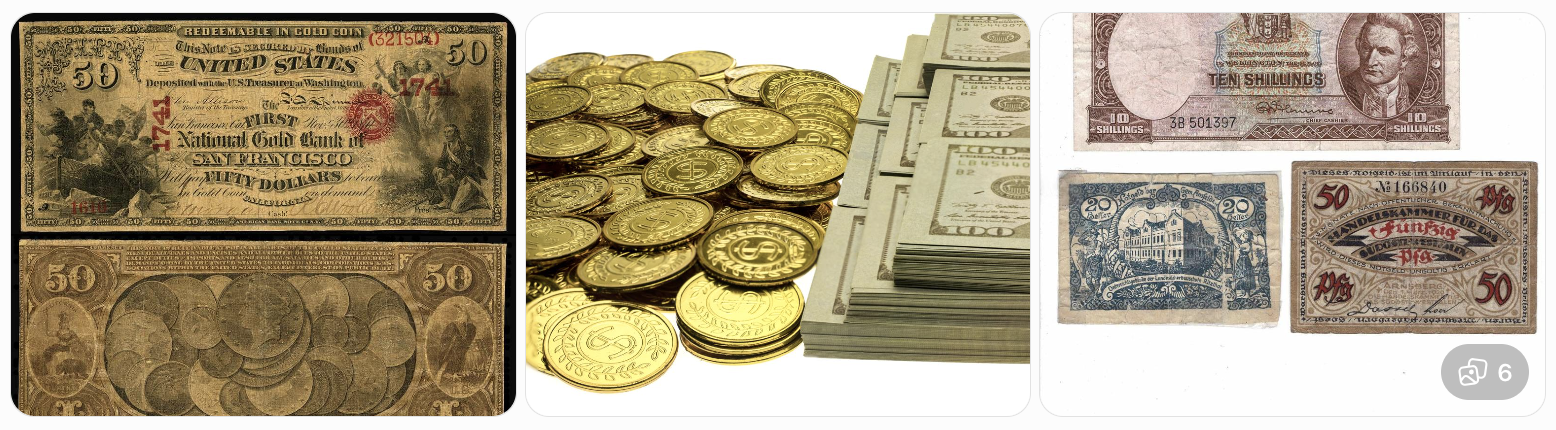
For centuries, precious metals played a major role in monetary systems.
Gold and silver were particularly important because they were scarce, durable, divisible, and widely accepted.
Eventually, many countries developed monetary systems linked to gold.
This became known as the Gold Standard.
Under a gold-standard system, the value of a currency was connected to a specified quantity of gold, subject to the rules of the particular monetary system.
However, maintaining a gold-based monetary system became increasingly difficult as economies grew.
Governments needed greater flexibility to respond to economic crises, wars, financial instability, and changing economic conditions.
Over time, countries moved away from gold convertibility.
The modern monetary system is primarily based on fiat money.
Fiat money has value largely because:
- The government recognizes it as legal tender.
- People trust that others will accept it.
- The monetary system provides institutional credibility.
- It is used to settle taxes and other obligations.
- Central banks and financial institutions support the functioning of the monetary system.
The Philippine peso, US dollar, euro, Japanese yen, and many other modern currencies are examples of fiat currencies.
This brings us to a fascinating realization:
Modern money is fundamentally based on trust.
7. Electronic Money: When Money Became Digital
The next major transformation came with computers and telecommunications.
Money increasingly moved from the physical world into the digital world.
Instead of handing someone cash, people could:
- Swipe a credit card.
- Transfer funds electronically.
- Pay bills online.
- Use ATMs.
- Send money through mobile applications.
- Pay with contactless technology.
- Store money in electronic wallets.
Today, when you check your bank balance, the majority of the value you see exists not as physical banknotes stored in a vault but as digital records within financial systems.
This changed the meaning of money once again.
Money no longer needed to be physically transported.
A transaction could occur between two people thousands of kilometers apart within seconds.
This digitalization dramatically accelerated global commerce.
8. Mobile Payments and Digital Wallets
The smartphone introduced another major stage in monetary evolution.
A device that fits inside your pocket can now function as:
- A wallet
- A bank
- A payment terminal
- An investment platform
- A trading terminal
- A financial information center
Mobile wallets and QR-based payments have made financial transactions increasingly accessible.
In the Philippines, digital payment platforms have become an increasingly important part of everyday financial activity.
A consumer can purchase food, transfer money, pay bills, or send funds to another person without physically handling cash.
This is one of the clearest examples of the convergence between finance and technology.
It is also the foundation of what we now call FinTech—Financial Technology.
9. Cryptocurrency: Challenging Traditional Money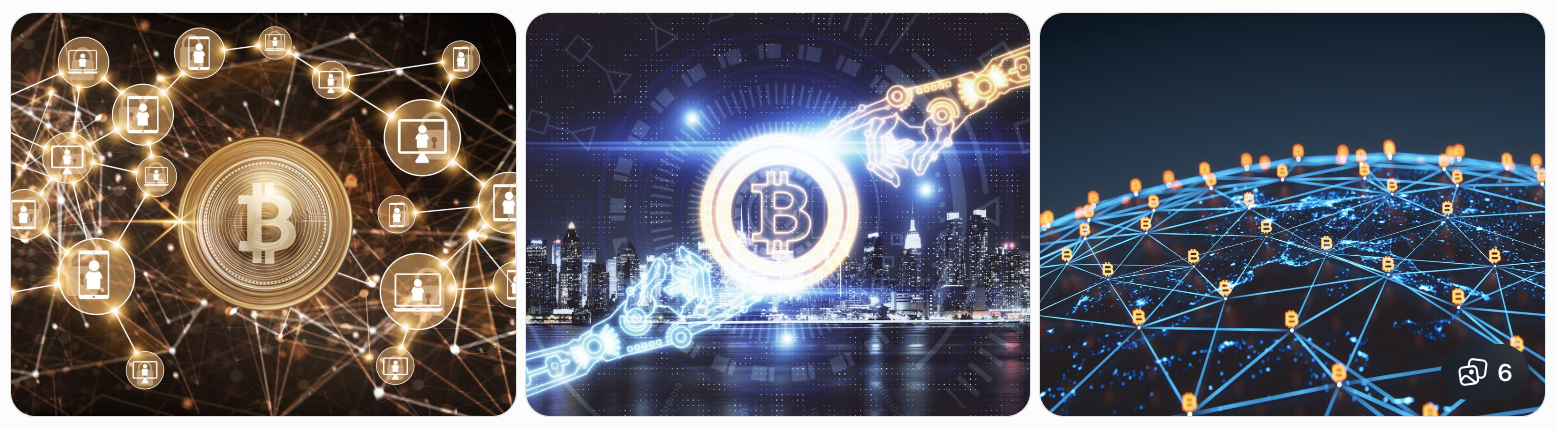
In 2009, Bitcoin introduced a radically different approach to digital money.
Traditional electronic money generally operates through centralized institutions such as banks, payment processors, and central banks.
Bitcoin introduced a decentralized architecture based on blockchain technology.
Instead of relying on a single institution to maintain the transaction ledger, Bitcoin uses a distributed network to verify and record transactions.
This introduced several important ideas:
Decentralization
No single central authority controls the Bitcoin network.
Digital scarcity
Bitcoin's protocol establishes a limited maximum supply.
Cryptographic security
Cryptographic techniques are used to secure transactions and ownership.
Distributed ledger technology
Transactions are recorded on a blockchain maintained across a network.
Cryptocurrencies expanded the conversation about what money could become.
They also introduced significant debates surrounding:
- Monetary sovereignty
- Financial regulation
- Privacy
- Security
- Volatility
- Decentralization
- Financial inclusion
- Investment
- Monetary policy
Whether cryptocurrencies eventually become a dominant form of money remains an open question.
But their impact on the evolution of finance is already significant.
10. Central Bank Digital Currencies: The Next Evolution?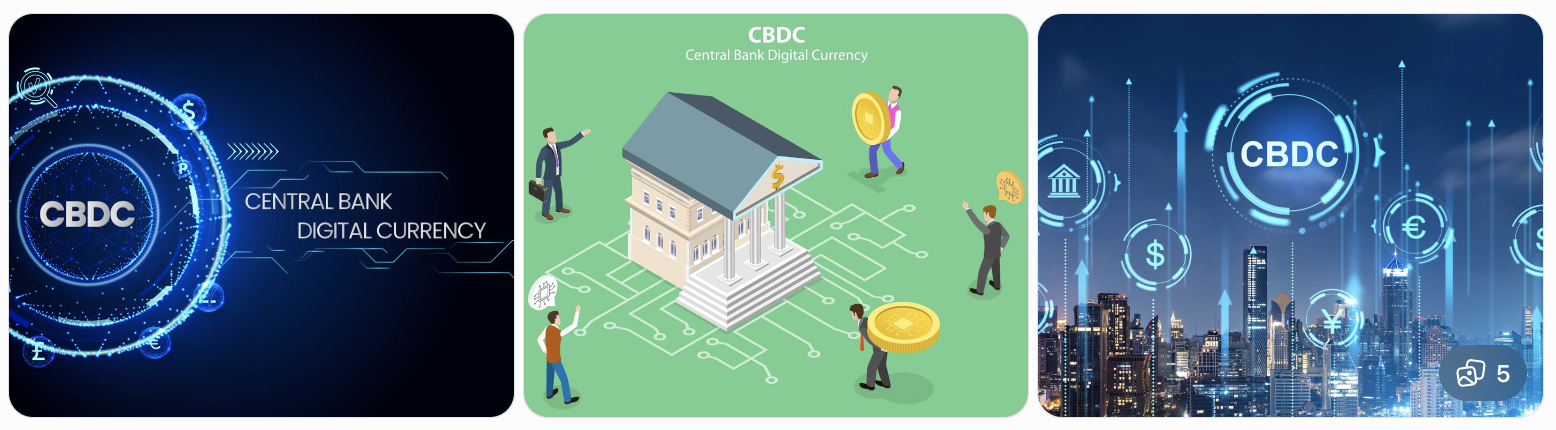
Another potential stage in monetary evolution is the Central Bank Digital Currency, or CBDC.
A CBDC is a digital form of a country's official currency issued or backed by its central bank.
Unlike decentralized cryptocurrencies such as Bitcoin, a CBDC would generally remain part of the country's centralized monetary system.
Central banks around the world have been studying or experimenting with CBDCs for different reasons, including:
- Improving payment efficiency
- Reducing transaction costs
- Expanding financial inclusion
- Modernizing payment infrastructure
- Increasing resilience of payment systems
- Exploring new forms of digital settlement
CBDCs raise important questions, however.
How should privacy be protected?
Who should have access to transaction information?
Should CBDCs replace cash or exist alongside it?
How would they affect commercial banks?
How could monetary policy change?
These questions demonstrate that the future of money is not simply a technological question.
It is also an economic, political, social, and institutional question.
11. The Future of Money: Artificial Intelligence, Blockchain and Beyond
The evolution of money is far from finished.
Emerging technologies are already changing how financial systems operate.
Artificial intelligence can analyze enormous amounts of financial information, detect suspicious transactions, automate financial decisions, personalize financial services, and support algorithmic trading.
Blockchain technology may enable new forms of digital ownership, settlement, tokenization, and decentralized financial applications.
Smartphones and connected devices may make payments increasingly invisible and automatic.
Meanwhile, central banks, commercial banks, FinTech companies, cryptocurrency networks, and technology companies continue to experiment with new financial infrastructure.
The future may involve a combination of:
Cash + Bank Deposits + Mobile Payments + Digital Assets + CBDCs + Blockchain + AI
Rather than one form completely replacing another, different forms of money may coexist and serve different purposes.
Evolution of Money at a Glance
| Era | Form of Money | Major Innovation |
|---|---|---|
| Ancient societies | Barter | Direct exchange |
| Early civilizations | Commodity money | Commonly accepted goods |
| Ancient world | Metal coins | Standardized value |
| Medieval/early modern period | Paper money | Lightweight representation of value |
| Banking era | Deposits & credit | Institutional finance |
| Modern monetary era | Fiat currency | Trust-based monetary systems |
| Digital era | Electronic money | Computerized transactions |
| Mobile era | Digital wallets | Instant mobile payments |
| Cryptocurrency era | Blockchain assets | Decentralized digital value |
| Emerging era | CBDCs & programmable finance | Digital sovereign money |
| Future | AI + blockchain + digital finance | Intelligent financial ecosystems |
What Does the History of Money Teach Us?
The history of money reveals a powerful pattern.
Money continuously evolves in response to the problems of its time.
Barter was inefficient, so societies developed commodity money.
Commodity money was inconvenient, so societies developed coins.
Coins became difficult to transport in large quantities, encouraging paper money and banking.
Paper and physical payments eventually became inefficient for global commerce, leading to electronic money.
Electronic finance evolved into mobile payments and digital wallets.
And dissatisfaction with aspects of centralized financial systems helped inspire cryptocurrencies and decentralized finance.
The technology changes, but the fundamental functions remain remarkably consistent.
Money must help society:
1. Exchange value
It allows people to buy and sell goods and services.
2. Measure value
It provides a common unit through which economic value can be compared.
3. Store value
It allows purchasing power to be transferred into the future.
4. Facilitate economic activity
It enables specialization, investment, trade, credit, and economic growth.
From Money to Financial Technology
The evolution of money also provides an important lesson for anyone interested in Finance, Economics, Trading, and FinTech.
Today's financial markets are no longer purely physical environments.
They are increasingly powered by:
- Algorithms
- Artificial intelligence
- Cloud computing
- Big data
- Blockchain
- Digital payment networks
- Quantitative models
- Automated trading systems
- Mobile applications
- Financial APIs
This is where finance meets technology.
The same historical process that transformed physical coins into digital transactions is now transforming traditional financial services into increasingly automated and data-driven systems.
For traders and financial professionals, understanding this evolution is particularly important.
The financial markets of tomorrow will require not only knowledge of economics and finance, but also an understanding of technology, data, mathematics, programming, and quantitative analysis.
Conclusion: Money Is a Story of Human Innovation
From a simple exchange between two people to instantaneous digital transactions across continents, the history of money is ultimately a story about human cooperation and innovation.
We have moved from:
Barter → Commodities → Coins → Paper Money → Banking → Fiat Currency → Electronic Money → Mobile Payments → Cryptocurrency → Digital Finance
And the journey is still continuing.
The most important lesson is that money is not merely an object.
It is a social and economic system built on trust.
Gold, silver, paper, bank balances, digital wallets, and cryptocurrencies may look completely different, but they all attempt to solve the same fundamental problem:
How can humans reliably represent, transfer, preserve, and exchange value?
As technology continues to advance, the form of money will almost certainly continue to change.
The real question is not whether money will evolve.
It is what money will become next.