
In today's financial markets, technology is changing the way people invest and trade. Gone are the days when traders relied solely on emotions and manual chart analysis. Computers now play a major role in executing trades with incredible speed and precision.
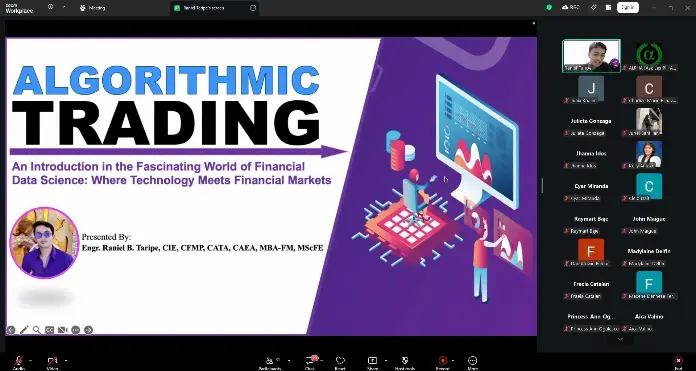
To help aspiring traders and technology enthusiasts understand this rapidly growing field, Quantalpha Algorithms Founder, Engr. Raniel B. Taripe, CFMP, CATA, CAEA, MBA-FM, MScFE, was invited as a guest speaker on ALPHA TV for a free webinar entitled "Algorithmic Trading: An Introduction to the Fascinating World of Financial Data Science, Where Technology Meets Financial Markets."
The webinar served as an eye-opening introduction to algorithmic trading, explaining how programming, mathematics, statistics, and finance come together to create automated trading systems.
What is Algorithmic Trading?
One of the first questions answered during the webinar was perhaps the most important:
What exactly is algorithmic trading?
Algorithmic trading is simply the use of computer programs to automatically execute trades in financial markets based on predefined rules. Instead of manually clicking the Buy or Sell button, traders create algorithms that monitor the market and execute trades whenever certain conditions are met.
These rules can be based on:
- Technical indicators
- Price movements
- Market volatility
- Risk management rules
- Statistical models
Once programmed, the computer performs the trading exactly as instructed.
Why is Algorithmic Trading Becoming So Popular?
One of the most surprising facts presented during the webinar is that algorithmic trading is no longer just for Wall Street.
According to the presentation:
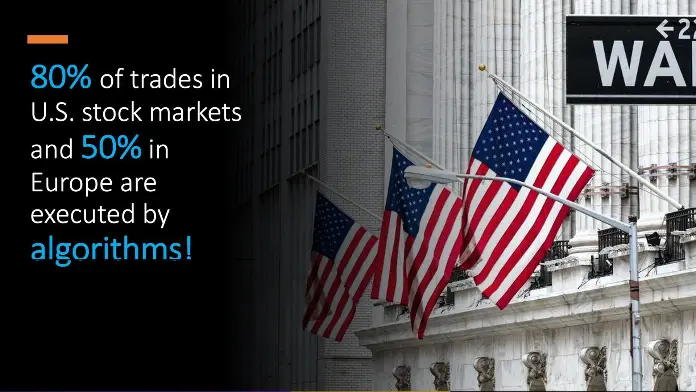
- Approximately 80% of trades in U.S. stock markets are executed using algorithms.
- Around 50% of European market trades are also algorithm-driven.
This demonstrates that automated trading has become a standard practice among financial institutions because of its speed, consistency, and efficiency.
Manual Trading vs. Algorithmic Trading
Engr. Taripe also explained the key differences between manual and algorithmic trading.
Manual Trading
Manual trading relies entirely on the trader.
The trader must:
- Analyze charts
- Watch the markets continuously
- Decide when to enter
- Decide when to exit
- Control emotions during winning and losing trades
While manual trading allows flexibility, it is also vulnerable to emotional decision-making.
Algorithmic Trading
Algorithmic trading follows a different approach.
Once the trading rules are programmed, the computer:
- Monitors the market automatically
- Detects trading opportunities
- Executes trades instantly
- Follows risk management rules consistently
- Never becomes emotional
This consistency is one of the biggest reasons why institutions continue investing heavily in trading automation.
Financial Data Science: Where Finance Meets Technology
One of the central messages of the webinar was that algorithmic trading is actually a branch of Financial Data Science.
This discipline combines multiple fields:
- Finance
- Mathematics
- Statistics
- Programming
- Data Analytics
- Machine Learning
Instead of making investment decisions purely through intuition, financial data scientists use data, mathematical models, and computer algorithms to make objective decisions.
Skills Needed to Become an Algorithmic Trader
For students wondering where to begin, Engr. Taripe emphasized that no one becomes an algorithmic trader overnight.
He highlighted four major skill areas:
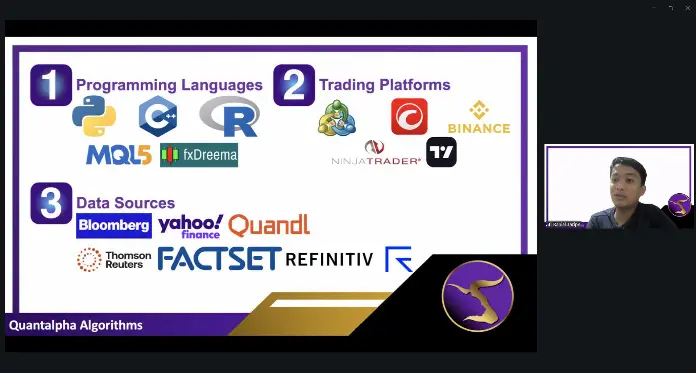
- Programming (such as Python and MQL5)
- Finance and Financial Markets
- Mathematics and Statistics
- Analytical Thinking and Problem Solving
The good news is that these skills can all be learned gradually with consistent practice.
Practical Advice for Students
One of the most valuable parts of the webinar was the practical roadmap for beginners.
Engr. Taripe encouraged students to:
- Learn Python or another programming language.
- Practice using free trading simulators before risking real money.
- Stay updated with financial market news.
- Join online trading and programming communities to continuously learn from others.
This advice reminds beginners that successful algorithmic trading is built on education, experimentation, and continuous improvement—not shortcuts.
High-Frequency Trading: When Speed Becomes an Advantage
The webinar also introduced High-Frequency Trading (HFT).
HFT systems are capable of executing thousands of trades per second, taking advantage of tiny price differences that humans simply cannot react to quickly enough.
To illustrate both the power and the risks of automation, Engr. Taripe discussed the famous Flash Crash of May 6, 2010.
During this event, automated trading systems rapidly amplified selling pressure, contributing to a sharp drop in the market before prices recovered. The case study highlighted that while algorithms can improve efficiency, they also require careful design, testing, and risk management.
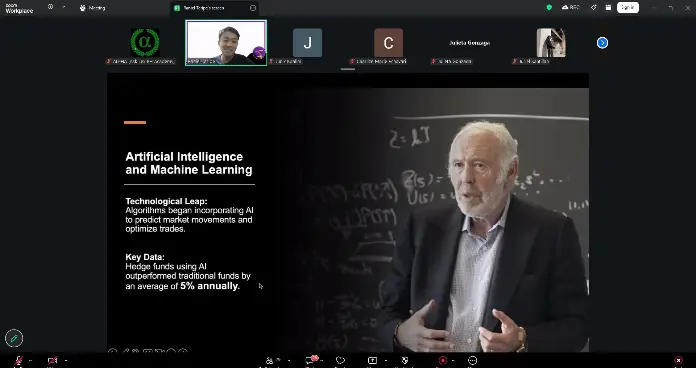
Artificial Intelligence is Changing Trading
Another exciting topic discussed was the growing role of Artificial Intelligence (AI) in financial markets.
Modern trading systems are beginning to use:
- Machine Learning
- Deep Learning
- Natural Language Processing
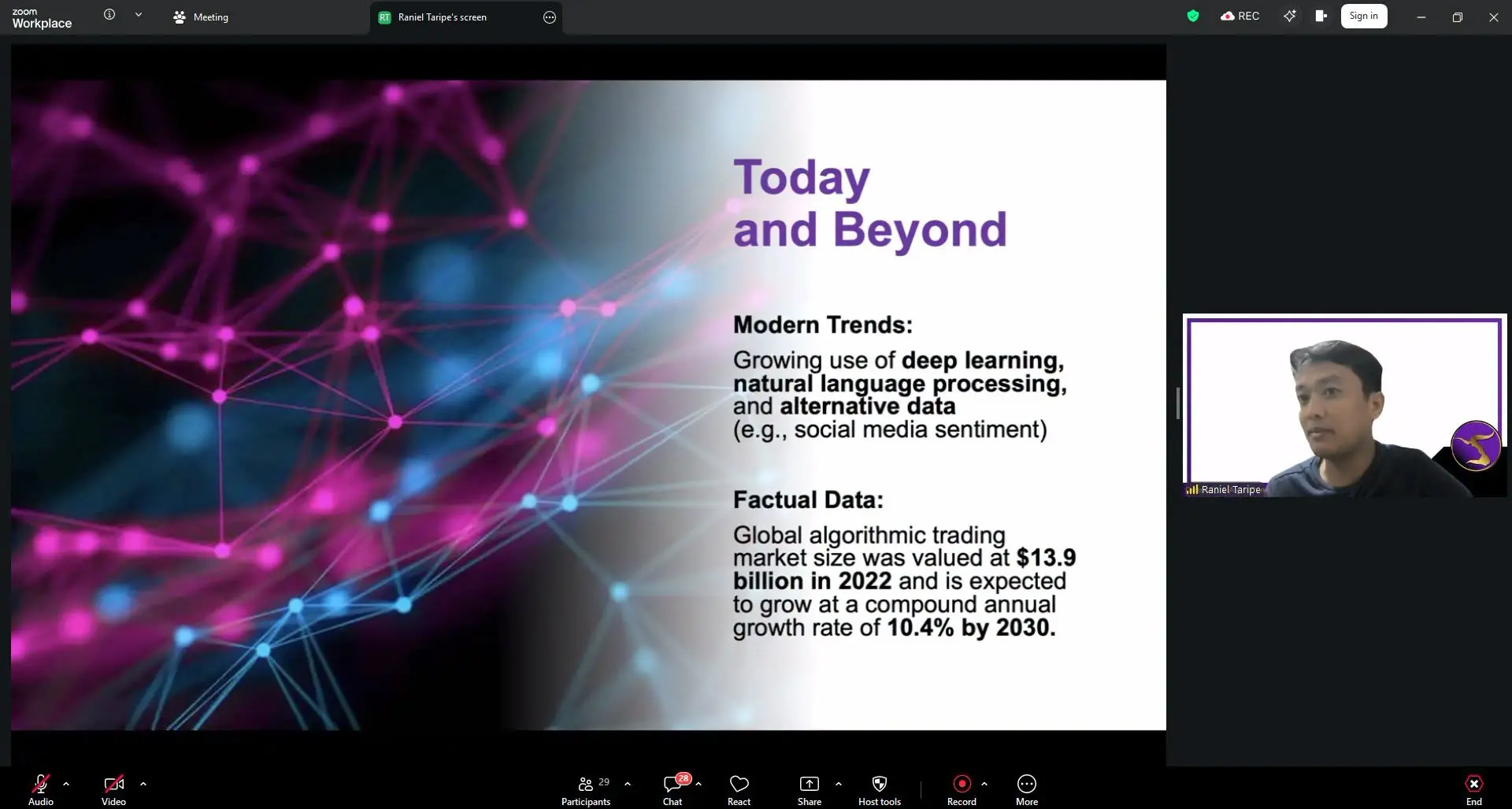
- Alternative data sources, including social media sentiment
The presentation also highlighted Renaissance Technologies as a pioneering quantitative hedge fund known for combining mathematics, statistics, and AI in investment strategies.
The Future of Algorithmic Trading
The webinar concluded by looking ahead.
According to the presentation, the global algorithmic trading market was valued at approximately $13.9 billion in 2022 and is projected to continue growing at a compound annual growth rate (CAGR) of 10.4% through 2030.
As computing power becomes more accessible and artificial intelligence continues to evolve, algorithmic trading is expected to become even more sophisticated and widely adopted across global financial markets.
A Valuable Learning Opportunity
Through this ALPHA TV guesting, Engr. Raniel B. Taripe successfully demonstrated that algorithmic trading is not merely about writing code—it is about combining finance, mathematics, statistics, and technology to solve real-world financial problems.
More importantly, the session showed students and aspiring traders that entering the world of quantitative finance is achievable with dedication, continuous learning, and a solid foundation in both programming and financial markets.
As emphasized throughout the presentation, algorithmic trading is not simply the future of trading—it is already shaping today's financial markets.
References
- Taripe, R. B. (2026). Algorithmic Trading: An Introduction in the Fascinating World of Financial Data Science, Where Technology Meets Financial Markets (ALPHA TV Webinar Presentation).
- The Economist. (2016). Too Squid to Fail.
- Investopedia. "Algorithmic Trading."
- U.S. Securities and Exchange Commission (SEC). The Flash Crash Report.
- International Institute of Industrial and Systems Engineers (IISE). Financial Engineering Resources.
From Charts to Code: Quantalpha Founder Introduces the World of Algorithmic Trading on ALPHA TV (AskLex PH Academy TV)