
What to Do After Your Final Defense?: A Complete Guide for Student Researchers
You’ve finally made it—your final defense is done. After weeks (or months) of sleepless nights, revisions, and intense preparation, you stood in front of the panel and defended your work. That moment alone is a huge achievement.
But here’s the reality: your journey doesn’t end after the defense.
Many students feel lost after hearing “Congratulations” or “Passed with revisions.” What comes next? This guide will walk you through the essential steps after your final defense, whether you're working on a capstone project or feasibility study.
1. Carefully Review the Panel’s Feedback
Right after your defense, your panelists likely provided the following via Minutes of Meeting:
- Corrections
- Suggestions
- Questions needing clarification
What you should do:
- List all comments immediately (while they’re still fresh)
- Categorize them:
- Minor edits (grammar, formatting)
- Major revisions (methodology, results, conclusions)
- Clarify unclear feedback with your adviser
👉 Tip: Treat feedback as refinement, not criticism. This is what transforms your work into a polished, publishable study.
Also, don't forget to give your panel, especially your adviser (since your adviser plays a crucial role in the success of your study) a certificate of appreciation and token as sign of your appreciation for them on sharing their insights, recommendations, expertise, energy and time to improve the quality of your study.
2. Work on Revisions Immediately
Don’t delay. The longer you wait, the harder it becomes to revisit your work.
Common revisions include:
- Rewriting unclear sections
- Improving data analysis
- Fixing inconsistencies
- Updating tables, charts, and figures
Best practice:
- Start with major revisions first
- Then proceed to minor edits
👉 Pro Tip: Track your revisions using a versioning system (e.g., “Final_v2”, “Final_v3”) to avoid confusion.
3. Coordinate Closely with Your Adviser
Your adviser is your strongest ally during this phase. Appreciate him/her because they are one of the reasons why you're able to produce a nice quality paper.
Make sure to:
- Send updated drafts regularly
- Ask for approval before final submission
- Confirm that all panel comments are addressed
👉 Remember: Some schools require adviser certification before you can proceed to final submission.
4. Prepare the Final Manuscript
After revisions, you need to finalize your document based on your institution’s format.
Check the following:
- Margin, font, spacing requirements
- Proper citation format (APA, MLA, etc.) - depends on your school requirement
- Complete sections (Abstract, Acknowledgment, References, Appendices)
Double-check:
- Spelling and grammar
- Consistency in terminology
- Accuracy of data
👉 Tip: Read your paper out loud—it helps catch errors you might miss.
5. Complete Administrative Requirements
Most universities require several documents before clearance.
These may include:
- Final manuscript (printed and/or digital)
- Approval sheets with signatures
- Plagiarism check results
- Clearance forms (library, department, etc.)
👉 Important: Ask your department for a checklist to avoid missing any requirement.
6. Submit Final Copies (Hardbound & Soft Copy)
Depending on your school, you may need:
- Hardbound copies (for library and department)
- Soft copy (USB, CD, or online submission)
Ensure:
- Proper cover format (title, names, date)
- Correct spine label (if required)
- Clean and professional printing
👉 Tip: Print extra copies—you might need them for job applications or portfolio use.
7. Prepare for Presentation or Publication (Optional but Valuable)
Some projects don’t end in the classroom.
You can:
- Present your study in conferences
- Publish in journals
- Showcase it in your portfolio or LinkedIn
👉 This is especially valuable if:
- Your study has innovative results
- You plan to pursue graduate studies
- You’re entering a research or technical career
8. Reflect on Your Learning
Before you fully move on, take time to reflect.
Ask yourself:
- What skills did I gain?
- What challenges did I overcome?
- What would I do differently?
This reflection is powerful—it helps you articulate your experience in interviews and future opportunities.
9. Celebrate Your Achievement 🎉
You earned this moment.
Whether it’s:
- A simple meal with your group
- A day of rest
- A small celebration
Take time to acknowledge your hard work.
10. Plan Your Next Step
Now that your capstone/feasibility study is complete, shift your focus.
Possible next steps:
- Graduation preparation
- Job hunting
- Certifications or further studies
- Building your professional portfolio
👉 Tip: Your capstone project can be a strong asset—use it to showcase your skills.
Final Thoughts
The final defense is not the end—it’s the transition from student work to professional-level output.
By properly handling revisions, submissions, and documentation, you ensure that your work reflects your true capability.
Remember:
“A great project is not just defended—it is refined, finalized, and presented with excellence.”
-----------------
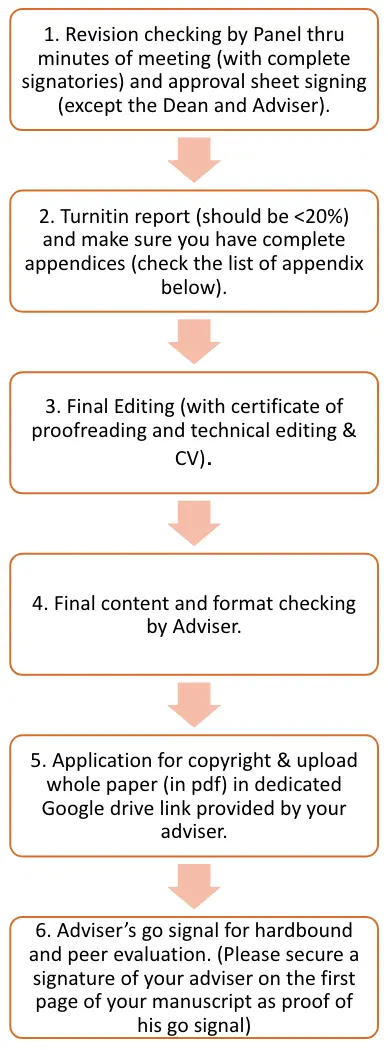
Below is the exact flowchart as next steps dedicated for QCU-COE Industrial Engineering Department after capstone or feasibility study final defense.
Documents to prepare as part of appendix (depends on the need of your research)
-Certificate of Testing (for food, cosmetics, electrical, etc related products).
-Complete minutes of meeting for all defenses (title to final defense, including all minutes of meeting for re-defenses).
-Photo documentation (for all defenses, for survey, for data gathering, for product/system testing, for certificate of appreciation and token, if any---these should be on different appendix numbers).
-QR Code directing to public google drive link (for videos/simulations).
-Copyright Application.
-Certificate of Statistical Validation/Testing (including survey reliability, statistical software used and the statistical treatment done in the study).
-Certificate of Proofreading and Technical Editing by Grammarian.
-Certificate of Validation by a Certified Public Accountant (for financial feasibility).
-Cost Breakdown.
-Letter request to company to conduct the study.
-Letter request to company to conduct the survey.
-Consent form (for surveys or interviews that is strictly confidential).
-Survey Questionnaire.
-Interview Guide Question.
-Observation Checklist.
-Raw Data.
-Survey responses (raw or summarized).
-Bionote of all authors.
-Screenshots (for system/softwares).
-Source Codes (for system projects).
-References.
For Feasibility Study, upload your full paper in pdf file here, with title format Section-Group#-Full Title. Sample: 4C-Group 9-AVOREX Solutions: A Feasibility Study on a Customizable Attendance and Payroll System for Medium‑Scale Enterprises
Here's the hardbound format for both capstone and feasibility study.
Join our DISCORD SERVER to know more about Industrial Engineering, Operations Research and Statistics! Join, engage, and learn with our community!
What to Do After Your Final Defense?: A Complete Guide for Student Researchers